What DIY candy kits actually cost in a Japanese supermarket
One shelf, one store, one afternoon. Every number on this page was read off the price tag in the photo below — nothing was looked up, estimated, or remembered.
Popin' Cookin' kits — the little boxes of powder that you mix with water to build a miniature hamburger, doughnut or pizza out of candy — turn up constantly in videos about Japan. What almost never turns up is the boring part: what they cost on an ordinary shelf, in an ordinary town, on a specific day.
So here is that shelf.
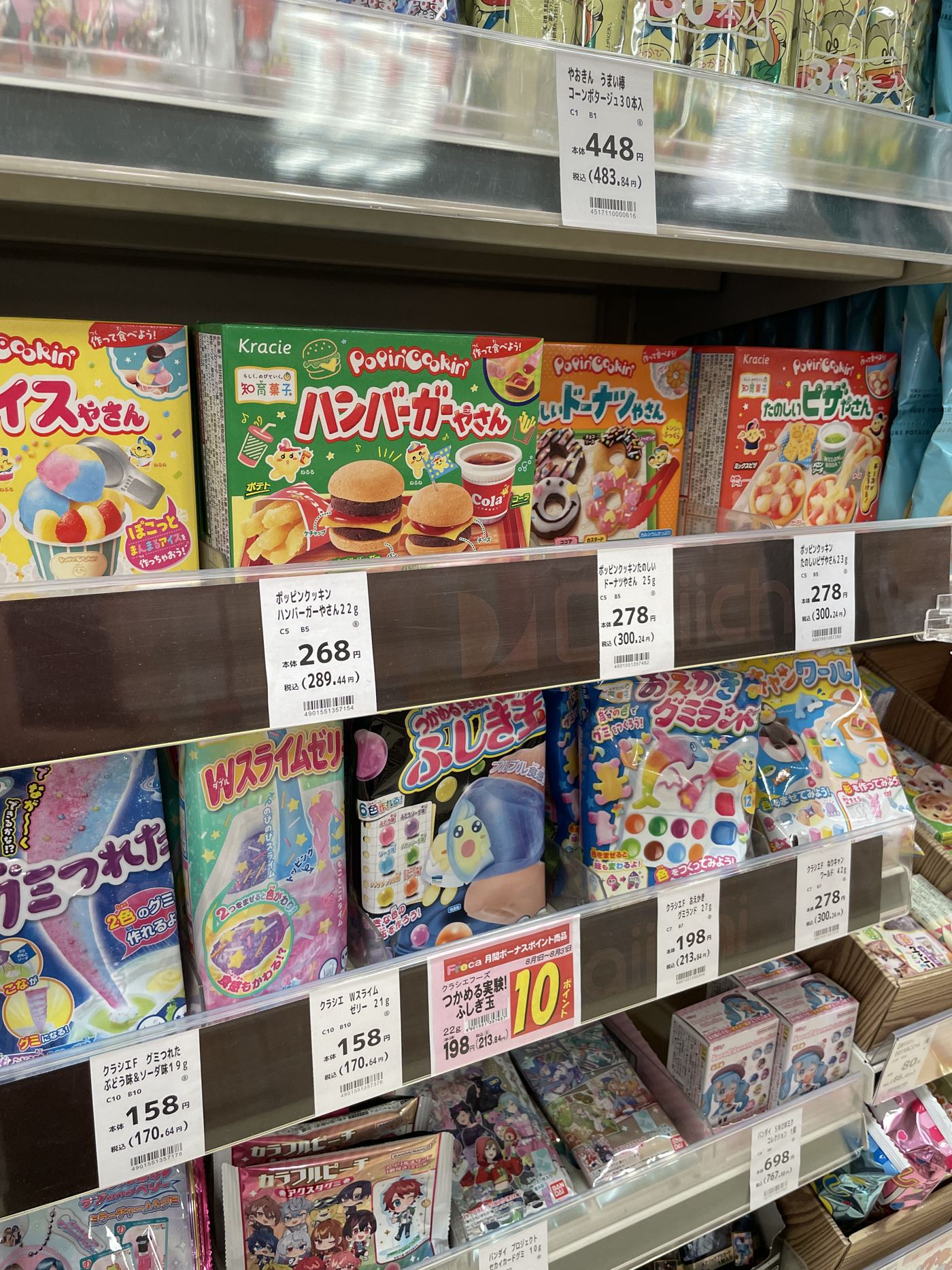
The prices on this shelf
| Item | Before tax | With tax | ≈ USD |
|---|---|---|---|
| Popin' Cookin' Hamburger, 22 gポッピンクッキン ハンバーガーやさん | ¥268 | ¥289.44 | $1.89 |
| Popin' Cookin' Doughnut, 25 gポッピンクッキン たのしいドーナツやさん | ¥278 | ¥300.24 | $1.96 |
| Popin' Cookin' Pizza, 23 gポッピンクッキン たのしいピザやさん | ¥278 | ¥300.24 | $1.96 |
| Kracie gummy-fishing kit, grape & soda, 19 gクラシエF グミつれた ぶどう味&ソーダ味 | ¥158 | ¥170.64 | $1.11 |
| Kracie double slime jelly, 21 gクラシエ Wスライムゼリー | ¥158 | ¥170.64 | $1.11 |
| Kracie "catchable bubble" kit, 22 gクラシエフーズ つかめる実験!ふしぎ玉 | ¥198 | ¥213.84 | $1.39 |
| Kracie drawing-gummy kit, 27 gクラシエF おえかきグミランド | ¥198 | ¥213.84 | $1.39 |
| Kracie mouldable-candy kit, 42 gクラシエF ねりキャンワールド | ¥278 | ¥300.24 | $1.96 |
| Umaibo corn-potage sticks, box of 30やおきん うまい棒 コーンポタージュ 30本入 | ¥448 | ¥483.84 | $3.16 |
A couple more tags sit at the edge of the frame, cropped or half-hidden behind a promotional card. They are left off the table rather than guessed at.
What this shelf is not. It is one branch of one chain — Daiichi, a regional supermarket in Hokkaido — on one day. Japanese supermarkets price independently, and the same box in a Tokyo convenience store, an airport shop or a specialty candy store can cost noticeably more. Treat these as a floor, not an average.
Why every tag shows two numbers
If you have only ever seen Japanese prices in a guidebook, the tags themselves are the confusing part. Each one carries two figures, and the bigger, bolder one is not what you pay.
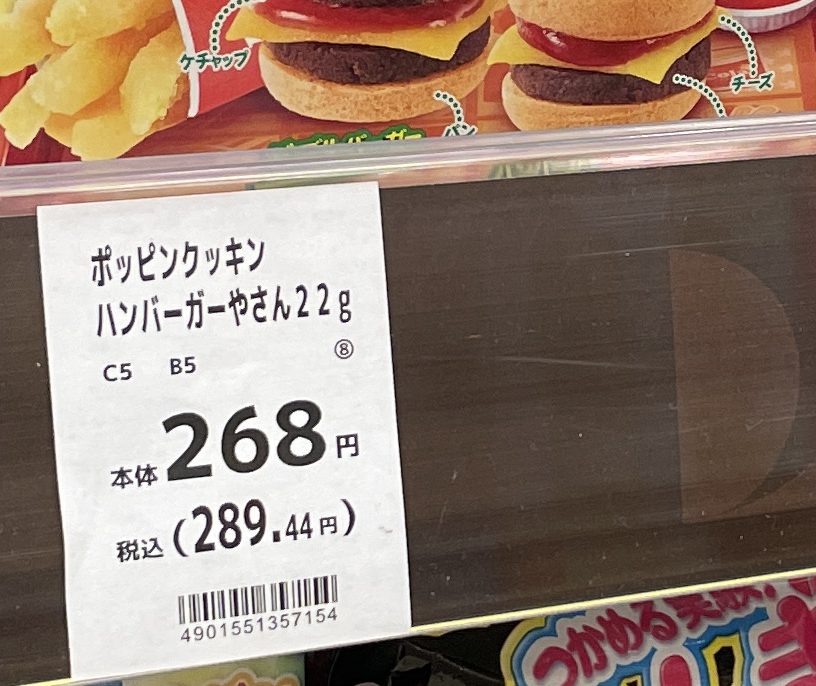
- 本体 — hontai, "the item itself". The pre-tax price. Printed large, because it is the number stores compete on.
- 税込 — zeikomi, "tax included". The number that actually leaves your wallet, usually printed smaller and in parentheses.
Japan applies a reduced consumption-tax rate of 8% to food and non-alcoholic drinks, against the standard 10% on most other goods. Candy counts as food, so every tag on this shelf follows the same arithmetic:
That is where the odd decimals come from. Yen has no everyday sub-unit in circulation — there is no coin smaller than ¥1 — so the fractions exist only on the tag; the register rounds when it totals your basket.
One practical consequence: when you compare a supermarket tag to a price you saw online, check which of the two numbers you are looking at. An 8% gap is easily large enough to make the wrong shop look cheaper.
For scale: chocolate on the next aisle
Same store, same afternoon. Useful mainly as a yardstick — it tells you whether a candy kit is a cheap souvenir or a splurge relative to what people here buy without thinking about it.
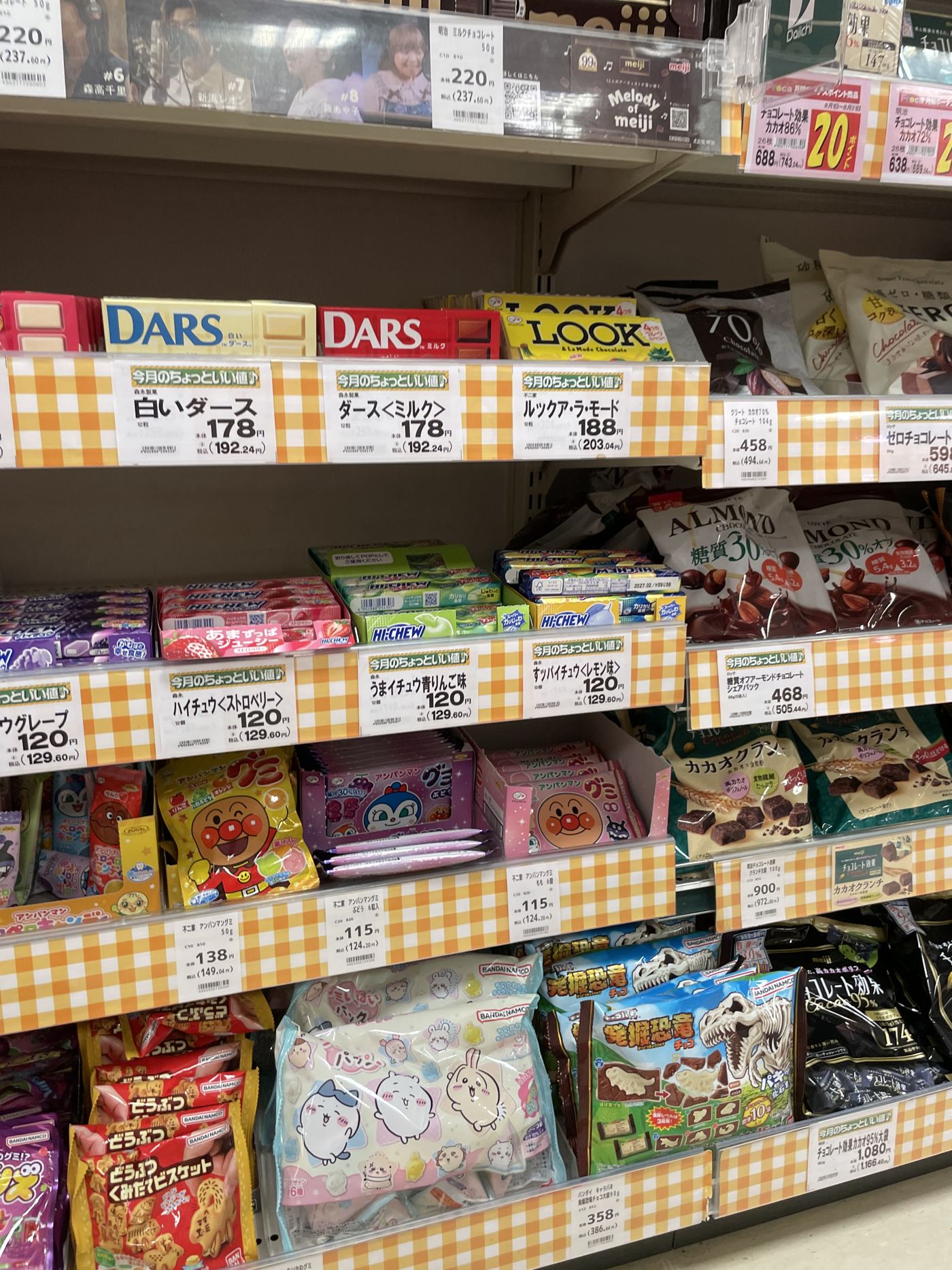
| Item | Before tax | With tax | ≈ USD |
|---|---|---|---|
| Morinaga DARS white, 12 pieces森永製菓 白いダース | ¥178 | ¥192.24 | $1.25 |
| Morinaga DARS milk, 12 pieces森永製菓 ダース〈ミルク〉 | ¥178 | ¥192.24 | $1.25 |
| Fujiya LOOK À La Mode, 12 pieces不二家 ルックア・ラ・モード | ¥188 | ¥203.04 | $1.32 |
So a DIY candy kit sits at roughly one and a half chocolate bars. On this shelf, on this day, none of it was expensive.
Reading a shelf like this yourself
Three things worth knowing before you stand in front of one:
- Grams are printed on the tag, not the box front. The 22 g and 25 g figures above come from the tags. These kits are small — the photographs on the box are considerably larger than what you get.
- Promotional tags look different from regular ones. The plain white tags on the candy-kit shelf are standing prices. The orange-checked tags on the chocolate shelf are a monthly campaign, so those three prices will not necessarily still be there.
- Supermarkets undercut the obvious places. These are the shelves locals buy from. Convenience stores, station shops and souvenir counters stock a narrower range at higher prices.
Prices photographed 10 August 2026. Currency conversion at ¥153.3 = US$1, the rate on 9 September 2026; it moves, so treat the dollar column as an approximation with a date on it.